Dave is putting together a list. He’d better not forget my favourites: Philip Seymour Hoffman, William H. Macy, M. Emmet Walsh, John Turturro, and the inestimable Jack Kehler.
Author: James McNally
Why I’m Not At Church Today
Brooke and I have struggled over the years to find a church home. Though I’d consider myself a convinced Christian, Brooke still has a lot of questions, and that’s a difficult situation in which to meet new people. I’ve also struggled personally for a long time trying to recapture the feeling of vibrant community with which I began my spiritual journey. I spent the 1980s as part of a pretty unique youth group and I suppose that’s been a hard act to follow. I’ve had to learn that those experiences can’t be recaptured.
Last week, I had the privilege of going out for dinner with two of my companions from those heady days. At one time in the late 1980s, we had all shared an apartment together. One is now director of an inner-city mission organization who recently survived a serious accident. While surfing in Hawaii, he was hit by a large wave and suffered a spinal injury. He was paralyzed and almost drowned, but has made remarkable progress and now is almost back to normal physically. Spiritually and mentally, this experience has changed him dramatically. He’s reaching out to his friends much more. He’s slowed down his workaholic habits. He’s savouring all the good things in his life. I don’t see this friend that often. The last time I saw him was at his 40th birthday last October, about a month before his accident.
The other friend is someone I still see quite a lot. He’s had a very different journey. Almost fifteen years ago, he sent me a letter from Ottawa, where he was living at the time. “I’m gay,” he told me. I was the first person who knew, and it fell to me to tell the rest of our highly-conservative friends. Over the years, he’s become estranged from Christianity to the point where he declares himself an atheist. And yet he’s still one of my closest friends. He will turn 40 this summer, just as I turned 40 in February. So, we’re all mellowing with age and thinking of what is important to us.
One of the things we talked about was church. And I got to thinking that one of the reasons I didn’t feel very enthusiastic about joining another church is that so many churches want you to join every activity they have going, and to focus your entire life, social and otherwise, around their program. I began to think that perhaps I already have a kind of church, a community of people whom I care about and who care for me. Many of them aren’t Christians, or are disillusioned “ex”-Christians, but isn’t that kind of irrelevant? Instead of trying to surround myself with people whom I’m supposed to be like, I’ve already surrounded myself with the people I am like.
And so instead of hurrying to commit to a new group of strangers who probably don’t need me, I’m rededicating myself to the people in my life with whom I don’t spend nearly enough time. It’s important to live out the love that I claim is so central to my faith. And we’ll see where it goes from there.
Lost Children
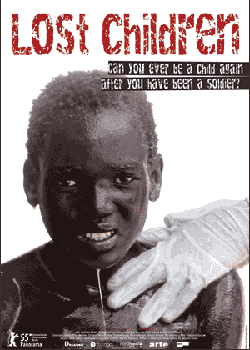
Lost Children (Germany/Uganda, 2005, Directors: Ali Samadi Ahadi, Oliver Stoltz, 98 minutes): All three of the films I saw today were about “children in peril” but none were more horrifying than this one. Northern Uganda has been caught up in civil war for almost twenty years. The rebels of the “Lord’s Resistance Army” make it their primary tactic to kidnap children from local villages, forcing them to fight in their army. Children as young as 8 are taught to kill with guns and knives, and those who don’t share in the atrocities are killed themselves, often by other conscripted children.
Catholic relief agency Caritas is running a reintegration centre for those children who manage to escape the rebel army. It is a formidable challenge. Often the children have physical injuries, either sustained in battle or in their harrowing escapes. The mental damage is much harder to repair. They often have nightmares, and are terrified of being reabducted. Their families are suspicious of them, and are also afraid of being targetted again by the rebels. In these circumstances, the social workers and doctors at the centre have their hands full.
We meet Jennifer, 14, who spent five years with the Lord’s Resistance Army, fighting government troops and terrorizing civilians, all the while being raped regularly as a commander’s concubine. And Opio, just 8 years old, describing how he bashed in a man’s skull with a rifle butt. Then there is sensitive Kelama, 13, who was forced to kill a woman in front of her child and who now can’t stop dreaming about her. All these children have a long road ahead of them, first reintegrating with their families and communities, and then hoping that the rebels don’t return for them.
It’s difficult to “rate” films like this, because they don’t really function as pieces of art. Instead, they fulfill another aspect of the documentary’s role, that of bearing witness. In that sense, this film is a clear-eyed look at some of the most horrifying crimes against children ever perpetrated. By making children do their killing for them, the so-called “Lord’s Resistance Army” have killed the childhoods of these children. As they piece together the shreds of their humanity, they are no longer children. What they will become is a mystery.
Information on helping the children here.
Coalition to Stop the Use of Child Soldiers
 (9/10)
Bunso (The Youngest)
Bunso (The Youngest) (Philippines/United Kingdom, 2004, Directors: Ditsi Carolino, Nana Buxani, 64 minutes): Tony is 13, Diosel and Bunso are 11. They are in prison for stealing. All around them are hundreds of other inmates, both minors and adults. The directors had unprecedented access to one of Manila’s prisons where the population are pretty much left to their own devices. Guards are rarely seen, and there are few private cells. Instead, the prisoners seem to feed, clothe and shelter themselves. The children are nominally part of the “Minor’s Ward”, but with over 150 crowded into one room, and exposed to the elements, many of them find somewhere else to sleep. Though violence and rape are only hinted at, it’s clear these tiny boys are in danger. A few of the adult inmates try to protect them, but wonder where their parents are. In many cases, the parents forced the kids onto the street in the first place, where many of them begged or stole out of hunger. For some, prison may actually be safer.
The filmmakers were working with UNICEF to document conditions in support of an overhaul of the juvenile justice system in the Philippines. The law has been ready since 1997, but getting any action from politicians has taken this long. There are signs that it might not be too much longer before children this young are spared the horrors of an adult prison. Unfortunately, it’s too late for those who have become hardened by their prison experience and end up back on the street to sniff glue and get into trouble with the law again.
 (8/10)
Xiara’s Song
Xiara’s Song (USA, 2004, Director: Liz Garbus, 36 minutes): Xiara is a precocious 7-year-old whose beloved father is in prison. She is not alone. More than 10 million children in the US have a parent incarcerated. This film examines the effect on the life of young Xiara. It’s clear that she idolizes her rapper father, and tries to stay connected with him by writing her own songs that she can sing to him over the phone. But she’s also angry and takes her frustration out on her mother, who has broken up with Xiara’s father. At one point, she admits that she started stealing, hoping that she would be caught and sent to the same prison as her dad. Despite his attempts to steer her clear of trouble, it’s unclear whether this bright and beautiful little girl will be able to hold her life together without his presence.
(8/10)